
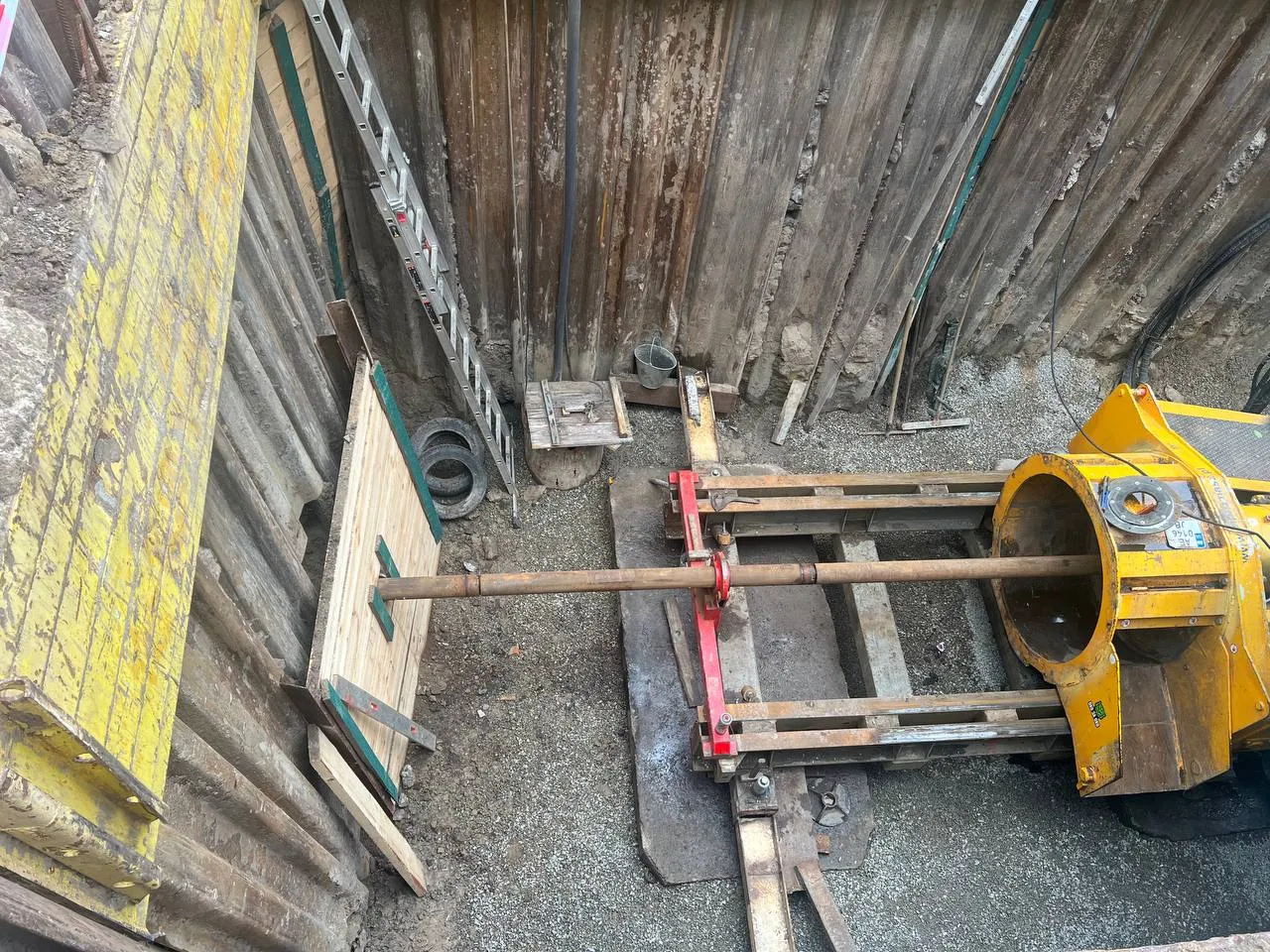
Pipe relining (rehabilitation)
Restoring worn pipelines from the inside with a polymer liner or PE pipe — without full network replacement or large-scale excavation.
How the work is carried out
A simplified scheme of the key stages. Scroll to see the sequence.
Typical applications
- Rehabilitating water mains and collectors while keeping the route
- Networks under roads and buildings where open-cut replacement is impossible
- Eliminating corrosion, cracks and leaks in old pipes
- Extending network life by decades without long service interruption
Things to consider
- Cleaning and video inspection of the section are mandatory before relining
- The bore is slightly reduced — verified by hydraulic calculation
- If the pipe is fully destroyed, renovation with replacement is more appropriate
Technical capabilities
Work stages
- 01
Survey
Site visit, initial data collection; tracing and video diagnostics if needed.
- 02
Estimate & quote
Engineering calculation, technology and material selection, commercial proposal.
- 03
Preparation
Method statement, equipment mobilization, pit and site setup.
- 04
Execution
Work under the approved design with quality control at every stage.
- 05
Testing & handover
Pressure testing, video check, as-built documentation, acceptance act.
What the customer gets
- Acceptance act and as-built documentation
- Testing / pressure test results
- Warranty obligations
FAQ
How does relining differ from renovation?
Relining restores the existing pipe from the inside (liner, coating); renovation is replacement — a new pipe is pulled in while bursting or expanding the old one. The choice depends on the network condition determined by video inspection.
How much will the diameter decrease after relining?
Slightly — by the liner thickness. Flow capacity often even increases thanks to the smooth inner surface.
How long does a relined pipe last?
Polymer materials are designed for decades of service; the exact lifetime depends on the liner material and network conditions.